Introduction
There is a need for a more holistic approach to fair AI, that includes technical steps, sociological activities, legal compliance measures and understanding, and ethical considerations. Addressing the need for AI systems free from discrimination requires a multidisciplinary approach that combines social, legal, and technical perspectives. Despite significant advancements in research and technical solutions, a gap remains between socio-legal and technical approaches.
Fair-by-design methodology refers to an approach in the field of AI where fairness considerations are integrated into the AI lifecycle from the outset. This methodology aims to ensure that AI systems are fairly designed, addressing potential biases or discrimination (according to a particular definition of fairness) during the design and development phase rather than attempting to rectify them after deployment.
Fair-by-design methodologies emphasize proactive measures to mitigate biases and promote fairness, such as using diverse and representative datasets, implementing fairness-aware algorithms, and incorporating transparency and accountability mechanisms into AI systems.
We address this complex problem by proposing a meta-methodology – namely, FairBridge – offering a reference for defining AI fairness methodologies that integrate all three perspectives (social, legal, and technical ones). The meta-methodology utilizes a questionnaire-based system where socio-legal and technical domain experts iteratively refine questions and responses, supported by automation.
Fair-by-design Approaches
The design of fair AI approaches involves a detailed analysis of the entire lifecycle of an AI system, as considering the non-discrimination aspects of an AI system requires constant actions and monitoring at every phase of the AI lifecycle. The analysis of the AI lifecycle and its relation to fairness actions begins with the analysis of the lifecycle itself from two different perspectives: i) the socio-legal perspective, and ii) the technical perspective.
The key takeaways are that there are significant gaps between these perspectives:
The technical point of view focuses on a narrower – and more limited – AI lifecycle compared to the broader social and legal perspective.
It is very rare for technical solutions to cover the entire AI lifecycle, because its narrower definition compared to its socio/legal counterpart.
Technical methods typically intervene at very specific phases.
Albeit there are significant differences from the socio/legal/ethical lens and the technical one, the core phases of the AI life cycle are shared by both perspectives: there is a clear identification of the necessity of carefully considering how data has been sampled (collected or generated), analyzing whether it contains any kind of bias, and studying how it has to be processed not to introduce further bias. Both perspectives also place careful emphasis on how AI algorithms should be evaluated for fairness.
More details the overview over the different perspectives and current gaps can be found in the following subsections:
Merging the gap between these perspectives is a crucial aspect of a fair-by-design methodology. FairBridge addresses this precise challenge.
Technical Lens
There is a dearth of fair-by-design methodologies tackled from the engineering/technology perspective. Technological approaches mostly focus on specific phases of the AI lifecycle (e.g., data collection, training of models, evaluation of results, etc.).
AI outside of the ML subfield is extremely underrepresented, and this is especially true from the technological point of view. This is a limitation:
There are many AI algorithms that do not fall into the ML categories whose impact to society and economy is non-negligible and whose behavior can be influenced by various biases.
We recommend researchers and practitioners to start increasing their attentions to other AI domains as well.

Technological methods to enforce fairness in ML are typically subdivided according to the phase in the AI lifecycle in which they can be applied. A broad classification is the following:
Pre-processing techniques approach the problem by removing the underlying discrimination from the data prior to modelling. This is argued in the literature to be the most flexible phase of repairing bias in the pipeline, as it makes no assumptions with respect to the choice of applied modelling technique. The methods, that modify the training data are at odds with policies like GDPR’s right to an explanation, potentially introducing new biases. Sufficient knowledge of the data and veracity assumptions are required.
In-processing techniques modify the traditional learning algorithms to account for fairness during the model training phase. They require a higher technological effort and integration with standard ML libraries to avoid porting challenges.
Post-processing is a set of methods that can be run on the output scores of the classifier as a post-training processing step to make decisions fairer. The accuracy is suboptimal when compared to “equally fair” classifiers and could be the case that test-time access to protected attributes is needed, which may not be legally permissible.
For a detailed survey on technical methods for enhancing fairness of AI approaches, we refer to the recent paper from [Calegari et al.].
Technological methodologies tend to adopt a reductionist approach, aiming at decomposing complex problems into a series of (hopefully easier) sub-problems. Under this solution paradigm, it is more “natural” to devise approaches that focus on specific fairness-related aspects, such as bias detection or mitigation, rather than to create holistic approaches encompassing the entire design process. This is compounded by the fact that a fair-by-design methodology can hardly be founded on merely technological grounds: a fair-by-design approach should encompass several aspects (e.g., dataset creation, data sampling, algorithmic choices, output evaluation, etc.) that should involve human-mediated elements, and thus cannot be entirely decoupled from sociological, economical, cultural and legal subtexts.
Bridging the Gap
Considering the entire AI system lifecycle is fundamental when assessing fairness and mitigating bias in AI systems:
It allows for a comprehensive understanding of how bias can infiltrate at various stages, from data collection and model training to deployment and impact assessment.
By examining the entirety of the process, we can identify and address potential biases more effectively, ensuring fairness across all stages of development and implementation.
The analysis of the socio/legal and technological lenses revealed how there is still a non-negligible distance between the two areas. It is very rare for technical solutions to cover the entire AI lifecycle, because its narrower definition compared to its socio/legal counterpart. More commonly, technical methods intervene at very specific phases.
The interplay between sociological/legal and technological perspectives is still in its infancy: engineering solutions tend to adopt excessively reductionistic approaches (discarding the big picture) while sociological/legal varied indications and suggestions struggle to coalesce into a set of well-defined and actionable guidelines which can be actually applied
Other gaps between the technological and legal perspectives stem from the relative lack of (effective) communication between legal experts (and lawmakers), ethicists and social scientists on the one hand, and technical experts (i.e., the developers of AI systems) on the other.
The socio/legal approaches tend to provide broader requirements and guidelines, refraining from defining how fairness should be measured in practice.
The technical approaches typically start with the aim of defining fairness metrics, requiring:
a definition of the fairness notions from social, legal, ethical and technical perspectives;
a quantitative mechanism to measure them (if possible).
Fairness notions vary by context and stakeholder, requiring different actions to achieve. They can be measured quantitatively using fairness metrics, but this leads to numerous metrics each capturing different aspects of fairness.
Summarizing:
There is a clear gap in current fair-by-design practice.
The integration of social, legal, ethical, and technological perspectives presents two challenges: complexity and interdisciplinarity.
Each perspective operates within its own framework:
Social, legal, and ethical perspectives focus on human behavior, ethical principles designed for digitalization, and regulation, while technological perspectives prioritize efficiency, functionality, and innovation.
Bridging these perspectives requires interdisciplinary collaboration.
This is compounded by cultural and contextual differences, which are crucial from the legal point of view.
Divergent priorities: technological perspectives often prioritize performance and scalability, whereas social and legal considerations emphasize accountability, equity and the protection of (fundamental) rights, democracy, and the rule of law.
Pace of change: technology evolves rapidly, outpacing the ability of social, ethical and legal frameworks to adapt. This misalignment leads to regulatory gaps and ethical dilemmas.
Lack of common vocabulary and/or conceptual framework: each discipline has its own vocabulary and ‘language’ and concepts whilst quite often referring to the same elements or objectives. Mapping and matching these diverging vocabulary and concepts are a lengthy but crucial process.
Information Flow Methodology (IFM): contextualized fairness by bridging social and technical perspectives
IFM Model: How the System Is Represented
The IFM model is the output of the IFM methodology, a representation of a sociotechnical system built from information sites and channels.
The model represents a decision-making system using information sites, which denote sources of information (for example, documents, datasets, or perceptual inputs), and information channels, which transform input from one or more sites into outputs at other sites. Examples of such transformations include recruitment decisions or sorting algorithms.
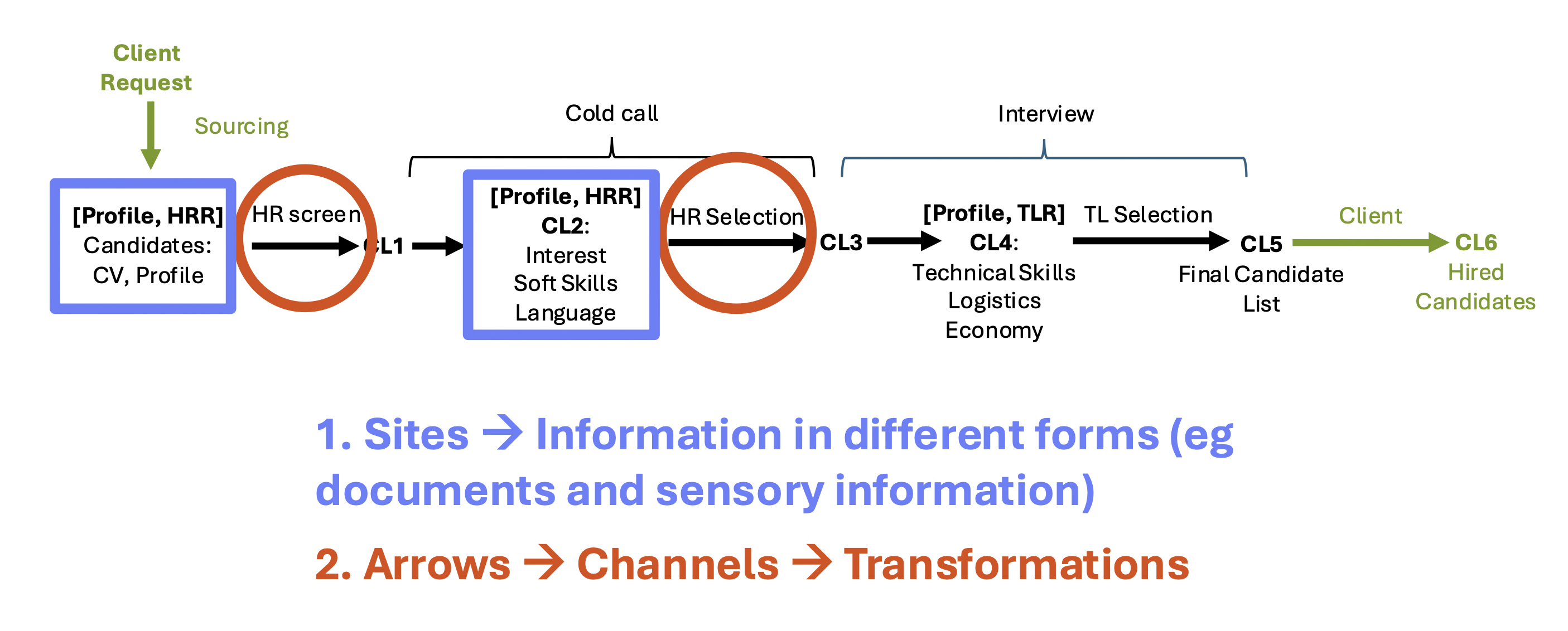
The information flow model is typically represented as a directed graph, as illustrated in the figure below. The model has a clear directionality: it can be thought of like a river with upstream and downstream flows, although here the flows move through information sites and channels.
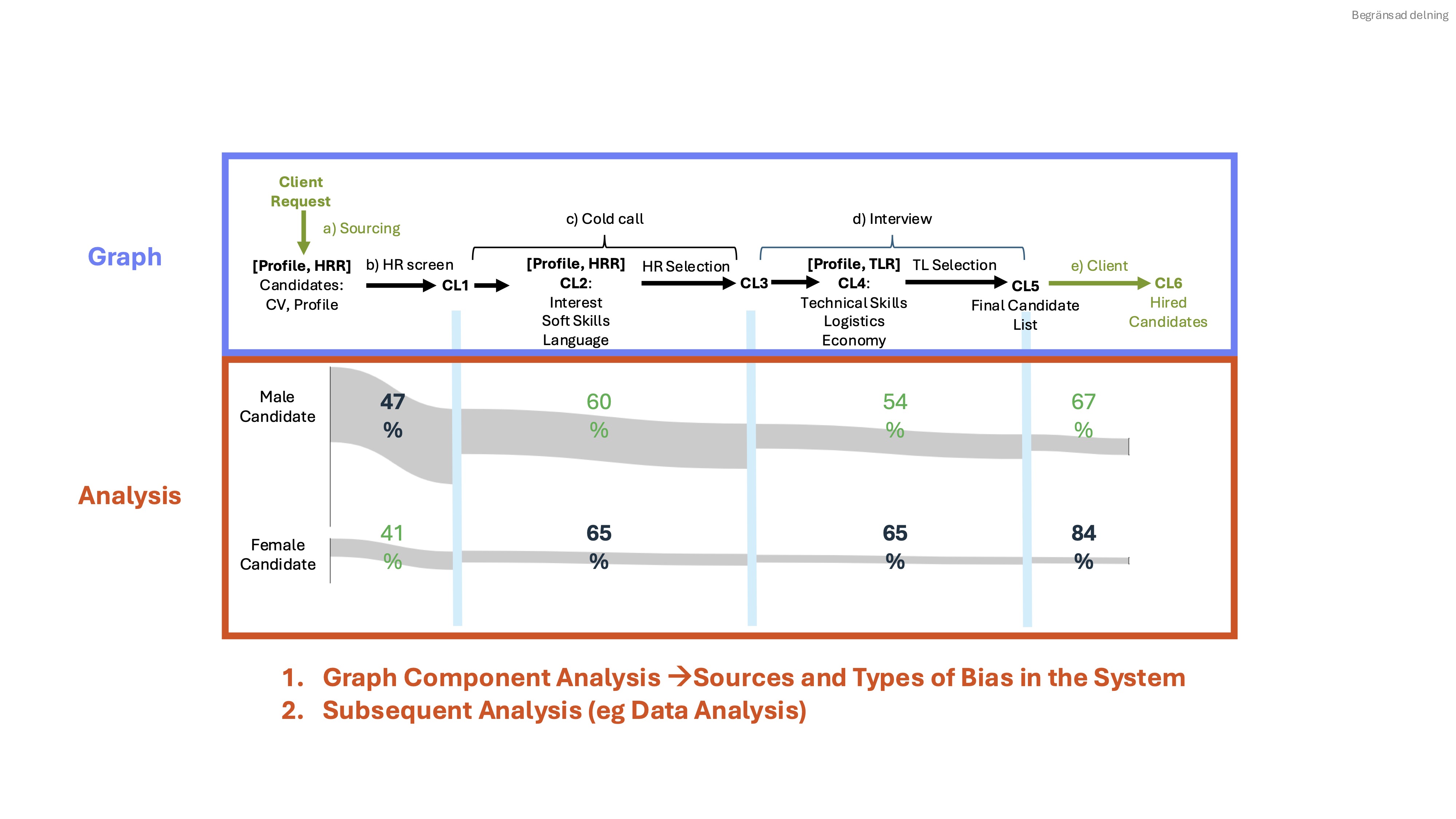
Using the IFM model, it is possible to analyse a sociotechnical system to understand the origins of biases in information sites and channels, how these biases propagate downstream, whether specific channels mitigate them, and which biases lead to impacts on different stakeholders.
Why the IFM Model Works
IFM can be used for multiple purposes. By creating a structural bridge between biases and stakeholder impacts, it enables methodical analyses such as FRIAS and supports the assignment of accountability by tracing the origins of biases. More broadly, this modelling methodology provides a structural base for a wide range of analyses.
To make effective use of IFM, each model must be grounded in a specific use case. This means that the model’s structure (including the sequence of information sites and channels, as well as their content) must be determined by the use case. This grounding makes IFM inherently situated, since each model reflects the contextual and operational realities of the system being analysed.
The IFM represents the decision-making process from start to finish, with a level of granularity that depends on the amount and quality of available information. Missing information is explicitly represented, helping identify potential biases and their downstream impacts. As a result, the IFM serves as a map of the system that ensures full use of the available information.
Importantly, IFM does not structurally distinguish between AI models and human decision-making processes: both are modelled as channels with input and output information. This integrated treatment makes IFM a holistic approach to analysing sociotechnical systems.
IFM Methodology: How the Model Is Built and Analysed
The IFM methodology is the participatory, six-step process used to construct and analyse the IFM model.
The involvement of stakeholders is crucial for making the IFM model situated and for determining the analytical focus, such as the types of impacts to examine and how these impacts emerge from the sociotechnical system. Stakeholders provide the initial input for identifying the relevant information sites and channels, as well as their sequence within the system. They then offer feedback that supports model refinement in Step 2, and they help concretise which types of impacts should be analysed in Step 5. The types of stakeholders that should be included in the participatory modelling are identified through the Stakeholder Identification Methodology.
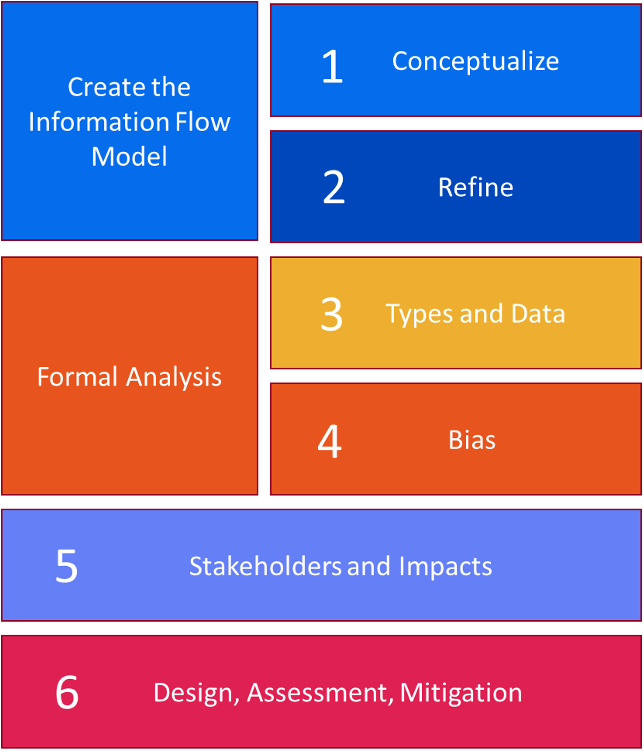
Steps 4 and 5 are primarily conducted by the IFM modellers. In Step 6, potential mitigation channels can be evaluated in terms of their influence on the impacts of interest. The six-step process can be extended or adapted depending on whether supplementary analyses are required.
Summary
IFM model = the structure (sites, channels, flows).
IFM methodology = the process (six-step participatory procedure).
The methodology produces the model, and the model supports analyses.
IFM forms a structural bridge between:
Bias and impact.
Technical properties and stakeholder outcomes.
Design choices and ethical guidelines.
This is possible because:
The focus remains on the actual use case.
It captures the entire decision process of the use context.
It incorporates missing information (rather than ignoring it).
It provides a continuous connecting structure.
It supports other tools, metrics, guidelines, and risk estimates by giving them a system-level foundation.
FairBridge: Converting Legal and Social Principles into AI Fairness Techniques
Modern computational systems are becoming increasingly complex, impactful, and pervasive, mostly due to the ever-increasing capabilities of AI technologies. As AI grows in autonomy and performance, it also becomes more widespread in applications that directly affect human lives, such as healthcare, justice, education, finance, etc. AI-powered systems tend to absorb, reproduce, and sometimes even amplify, the biases present in the data they are trained on, or in the people who design them.
To mitigate this issue, recent efforts in AI-fairness research have been focusing on either:
developing statistical algorithms for detecting and mitigating biases,
defining guidelines and best practices for ensuring fairness in ac{AI} systems.
We propose a meta-methodology for fairness engineering, consisting of a stable set of core principles and an evolvable pool of practices for steering end users towards a deeper understanding of the problem/domain they are dealing with, and for guiding their decision-making. The meta-methodology should then be reified into a guidelines-provisioning software system whose capabilities and degree of automation can be incrementally improved, as prescribed by the meta-methodology itself.
We propose developing the Fair-by-Design via an incremental approach,
starting from an initial version to be repeatedly refined.
The Meta-Methodology
Fairness notions vary by context and stakeholders, requiring different activities for fulfilment. Legal and social perspectives on fairness are case-dependent, interpreted differently, and influenced by social and institutional factors; setting thresholds for what is fair or unfair. Current Fair-by-Design practices have a clear gap due to the challenges of complexity and interdisciplinarity in integrating multiple perspectives. These insights can be summarized as follows:
Fair-by-Design approaches require the collaboration of an interdisciplinary team;
Fair-by-Design methodology should be tailored according to the context.
For this purpose, we propose a meta-methodology rather than a single methodology; we want to provide tools for building fair methodologies. Both socio-legal and technical experts shall operate this tool.
Practical attempt to build a Fair-by-Design methodology should keep into account the following desiderata:
the methodology should consider the cultural context and the domain in which the ac{AI} system is going to be applied;
the methodology should adapt to any change in the cultural context as it evolves;
the methodology should assist experts in the activity of translating the social, legal, and ethical requirements into technical requirements but without replacing the human decision-maker;
the methodology should account for pre-existing datasets and algorithms as the basis for the fair AI system to be developed.
Such a reiterated approach is paramount to ensure that the resulting methodologies are kept up-to-date as the contexts evolves. In practice, we want to provide a tool (the meta-methodology) to build and adjust Fair-by-Design methodologies for AI. This degree of separation is important as while the fairness methodology depends on the context and needs to be tailored to its specific domain, the meta-methodology can instead be general and shared across different social and legal contexts.
We require a Fair-by-Design methodology to be based on a Questions/Answers
(Q/A) mechanism
The questions and their admissible answers should be designed to deepen decision-makers understanding of the problem and the domain they are dealing with, and to make them aware of any relevant issues concerning their application scenario —hence guiding their decisions accordingly. For this reason, the questions and answers should be designed by experts in law, sociology, statistics, and computer science.

Actors Types
FairBridge is intended to be used by organizations whose goal is to develop fair AI algorithms. These algorithms are assumed to be eventually composed into AI systems, and these systems are expected to be used by some end-users.
For instance, end users could be private individuals or companies as well as public institutions or civil society organizations willing to use the final AI system.
End-users may also include “affectees”, i.e., people affected by (subjected to) the decision of an AI system being used by somebody else% —e.g., job applicants, or welfare recipients.
End-users are not the actual users of FairBridge. The actual users are the members of the organizations who are responsible for developing the AI systems. These members are divided into two categories:
Business users are responsible for any decision concerning the target AI system. They should be in the position of making decisions. In particular, they are the ones who should answer the questions. For this reason, they should have sufficient background knowledge to understand the questions and the admissible answers, or know who to ask for help when this is not the case.
Technical users are responsible for the actual implementation of the AI system, following the decisions taken by the business users. In practice, they are software developers, data scientists, and so on, hence they possess adequate technological expertise to develop AI systems.
The Q/A mechanism should include questions aimed at identifying the stakeholders, in such a way their existence and views can be included in any fairness-assessment and enforcing action. A similar argument holds for the potential end-users of the target AI system, whose profile should be identified and taken into account by the Q/A mechanism as early as possible.
Questions/Answers Flow
The Q/A mechanism is the core of the FairBridge system, and it is the main tool by which the meta-methodology is reified into a practical software system. It involves a set of relevant questions and their admissible answers, plus a partial ordering relation, which defines the order in which the questions should be asked to the business users. The answer to a question may impact which and how many questions are asked later on to the same business user.

Even if the graph is the same for all business users, each business user may follow a different path, depending on their particular use case, domain, goals, and constraints. In other words, the graph represents the whole set of questions and answers, and their ordering, while the path represents the subset of questions and answers that are shown to one particular business user. The Q/A graph is designed, filled, and refined by experts, as prescribed by the meta-methodology. Conversely, Q/A paths are constructed by business users and technical users and they are tailored to the specific needs of the organization they belong to.
Social, Legal and Ethical Technical Lens
There is no such thing as a consolidated method for fair-by-design AI. We are transitioning from an industrial society to an “AI society”, driven by two key forces: stratification and association, representing vertical and horizontal movements. Existing social divisions and inequalities persist, but new forms are emerging as social structures, economic relations, and computational systems intersect. Understanding these contextualized features of AI is crucial to avoid the abstraction error often made in computer science, which overlooks social context.
A very relevant notion is that of situated knowledge underlying knowledge production and the power relations among relevant stakeholders.
Revealing ML’s social world is key to understand the emergence of bias and discrimination in the ML algorithms and models themselves.
Since AI-systems have spread in both public and private sectors, discussion about algorithmic fairness has arisen. Fairness usually relates to the intent of achieving a larger, mainly social, overarching goal, such as ‘fair’ hiring, welfare service delivery, and lending. One important claim to a fair-by-design social methodology is about the choices and assumptions that are made in the design process, which could and should be more inclusive.
To diagnose and mitigate biases in AI, it is important to differentiate between individual and group-level fairness. Individual fairness means that similar individuals should be treated similarly, and group fairness means that the outcomes of an AI system should not vary if the population is split into groups (e.g., by protected attributes). An important strand of literature seeks to implement mathematical fairness metrics to assess a model’s impartiality towards subgroups. Different statistical fairness metrics lead to varying ways to assess bias in a AI system.
Fairness Social Perspective
The first action is to understand technology through a socio-technical lens that sustains the acknowledgment of mutual influences between technical and social structures. This passage is required to highlight the culture of and modes of knowledge production in computer science that betrayed the social goals the field was trying to achieve.
Distributive fairness refers to the fairness of the outcomes (aims) of decision making, while procedural fairness refers to the fairness of the decision-making processes (means) that lead to the outcomes.
Technology is the result of a process of social construction with the contribution of a variety of stakeholders.
Disparate impact happens when members of a marginalized class are negatively affected more than others when using a formally neutral policy or rule.
Disparate treatment refers to the situation where an individual is intentionally treated differently based on their membership of a marginalized class.
Neither disparate impact nor disparate treatment aim exclusively at distributive fairness
The sociological and legal domains are still in the process of converging toward a unified methodology for fair-by-design AI, albeit strong effort is currently being invested - consider for instance the European AI Act. Technological solutions are consequently not sufficiently regulated (or there are not sufficient incentives towards fairness), nor the legal and social contexts are sufficiently stable to provide unequivocal guidelines that could be applied by technicians without guidance from legal/social experts.
Fairness Legal Perspective
The legal relevance of AI was reflected in the EU Ethics Guidelines for Trustworthy AI (EGTAI), as one of the 3 pillars upon which trustworthy AI rests. AI systems do not operate in a lawless world. A number of legally binding rules at European, national and international levels already apply or are relevant to the development, deployment and use of AI systems today. Legal sources include, but are not limited to: EU primary law (the Treaties of the European Union and its Charter of Fundamental Rights), EU secondary law (such as the General Data Protection Regulation, the Product Liability Directive, the Regulation on the Free Flow of Non-Personal Data, anti-discrimination Directives, consumer law and Safety and Health at Work Directives), the UN Human Rights treaties and the Council of Europe conventions (such as the European Convention on Human Rights), and numerous EU Member State laws. Besides horizontally applicable rules, various domain-specific rules exist that apply to particular AI applications (such as for instance the Medical Device Regulation in the healthcare sector).
Moreover, recent regulatory developments around AI are laying down technical, social, ethical (and general legal) fairness notions in specific legal requirements. The EU AI Act is bound to set technical (design) requirements for high-risk AI systems to ensure the protection of fundamental rights (such as the right to non-discrimination), by demanding for example (that):
High-risk AI systems undergo a fundamental right, identification and impact assessment (proposed).
(…) elimination or reduction of risks as far as possible through adequate design and development; (art. 9 (4) (a) AI Act)A.
Training, validation and testing data sets [of high-risk AI] shall be relevant, representative, free of errors and complete. They shall have the appropriate statistical properties, including, where applicable, as regards the persons or groups of persons on which the high-risk AI system is intended to be used (art. 10 (3) AI Act).
High-risk AI systems shall be designed and developed in such a way, including with appropriate human-machine interface tools, that they can be effectively overseen by natural persons during the period in which the AI system is in use (art. 14 (1) AI Act).
High-risk AI systems shall be designed and developed in such a way that they achieve, in the light of their intended purpose, an appropriate level of accuracy robustness and cybersecurity, and perform consistently in those respects throughout their lifecycle (art 15 (1) AI Act).
Despite all of this, legal methodologies for AI fairness-by-design are scarce and often limited to one phase of the lifecycle or one particular regulation. Often these methodologies lack clear guidance regarding which assessment element is relevant at which stage of the AI-lifecycle and who should be involved when and how. As we have seen that unfairness or bias can creep in at all stages of the AI-lifecycle, a more targeted legal methodology is necessary, especially with regard to the upcoming AI Act that holds numerous requirements and obligations directed at different stages of the AI lifecycle.